FYI | SPONSORED CONTENT
Melee: Small Stones, Big Impact
Charles Evans
Berco Jewelry
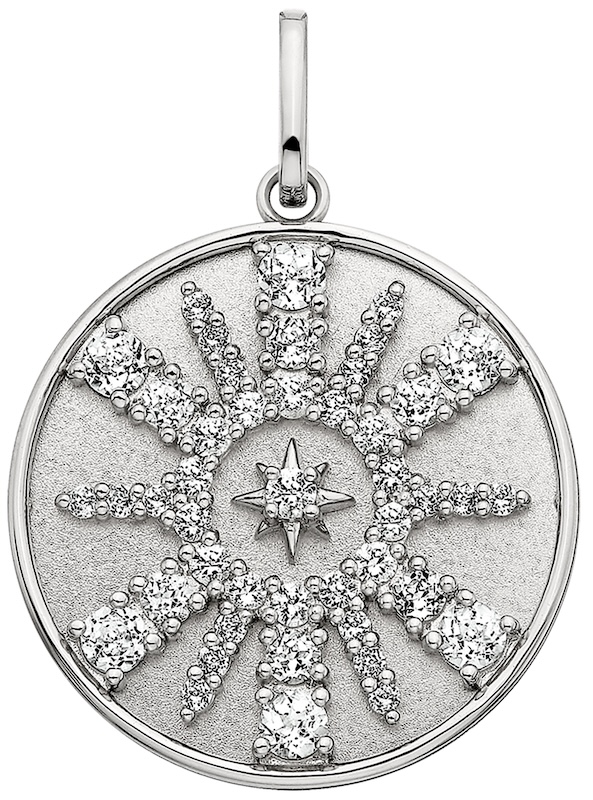
White topaz sunburst
sterling medallion charm
MSRP $355
bercojewelry.com
800.621.0668
In the world of jewelry, there are unsung heroes who offer sparkle and shine all year long: melee. These small stones rarely receive the spotlight given to center stones, yet they are the backbone of a huge portion of the jewelry market and keep much of the global supply chain moving.
Melee gemstones are typically under 0.20 or 0.30 carats and can be as small as two thousandths of a carat in diamonds or around 0.7 mm in colored stones. Tiny, yes—but mighty.
Consider diamonds. Roughly 90 percent of global polished diamond production by weight becomes melee, representing about 20–25 percent of annual market value. In more visual terms, out of every 10 diamonds faceted for the jewelry industry, 9 are melee under 0.10 carat. Economically, this means most mines depend on selling these small stones just to stay in business.
The same holds true for colored stones. If miners cannot sell the small material, they cannot afford to keep digging for the larger, headline-making gems.
Take tsavorite as an example. More than 95 percent of tsavorite production is under half a carat. That huge percentage accounts for only about 15 percent of the total market value—but that share is growing, and it is increasingly important to miners. As recently as 2010, there was no real demand for tsavorite melee under 2 mm. Today, the market asks for calibrated and graded diamond-cut rounds down to 0.8 mm. That vivid tsavorite green is perfect for nature-inspired, melee-heavy designs— what could be better for the wings of a butterfly or the leaves of a floral motif?
How, then, should a jeweler approach melee?
As a jeweler, it pays to understand current pricing, insist on consistent sizing, and take the time to know the story of each gemstone. Build a product range and sales strategy that clearly differentiates between natural and laboratory-grown material and ensure staff can present both with confidence and enthusiasm. And yes—enjoy the margins.
For bench jewelers, most diamond melee has long been machine-cut, bringing the size consistency that makes setting efficient and reduces breakage. We now see the same shift with colored-stone melee. Instead of countless tiny workshops with hand or foot-cranked laps, more production is mechanized. One major driver is simple economics: the cost of rough has risen, and well-cut melee commands higher prices. Melee cutters are no longer living off crumbs from the cake.
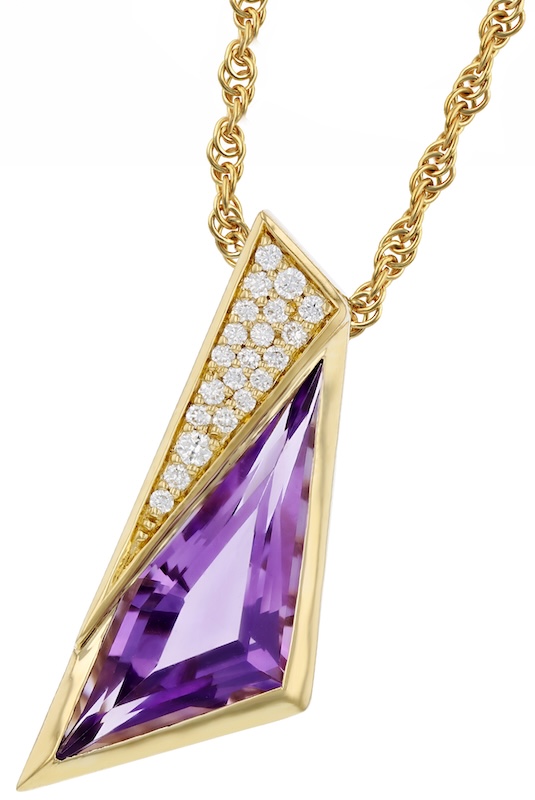
Allison-Kaufman Co.
14K diamond and
amethyst necklace
MSRP $3,327
allisonkaufman.com
800.800.8908
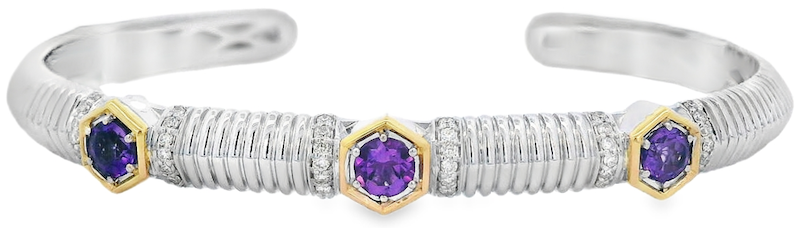
Piyaro
Silver hex bracelet with 14K accent amethyst & diamond
MSRP $1,997
piyaro.com
888.427.8886
Machine cutting has also raised expectations. Consistent sizing is now taken for granted, and we can thank the watch market—with those “blinged” bezels on luxury timepieces—for helping create the demand for precisely cut small stones. The whole industry benefits: jewelers receive a more reliable product, reject rates and breakages drop, and it is easier to keep popular sizes and varieties in stock instead of nervously picking through a breakouts jar at the last minute.
For store owners, melee powers the halos, clusters, eternity bands, and intricate colored-stone pieces that you want to move in volume during the holiday season. These are often the designs that convert browsers into buyers, delivering visible sparkle at approachable price points. Colored gem melee multiplies your storytelling options, origins, birthstones, and custom combinations, while elevating designs without requiring a large center stone.
Train staff speak confidently about the quality and origin of the smallest stones and keep pricing knowledge current. Colored gemstone melee rarely gets cheaper. Customers whose budgets don’t stretch to a perfectly saturated, flawless emerald center stone may still be able to enjoy top-quality emerald melee in their piece. Turn what might seem like a technical category into a selling strength.
And for the most important people in the chain, the holiday customer, help them see that what feels like a small indulgence can actually be a vital link in the global supply chain. Without modest purchases that include the tiniest gems, that ripple never reaches the miner and their family. Every pavé band, every cluster earring, every delicately set accent stone helps sustain the volume that keeps mines operating and communities employed.
This season, the small stones deserve recognition for the outsized impact they quietly deliver.
Thank you, little guys. You are the elves in the workshop that always deliver.

Credits: Paul Zimnisky http://www. paulzimnisky.com Bruce Bridges and Bridges Tsavorite http://www. tsavorite.com/ Charles Evans BSc (Gemmology and Jewellery) FGA, DGA, Senior Gem Buyer at Stuller Inc