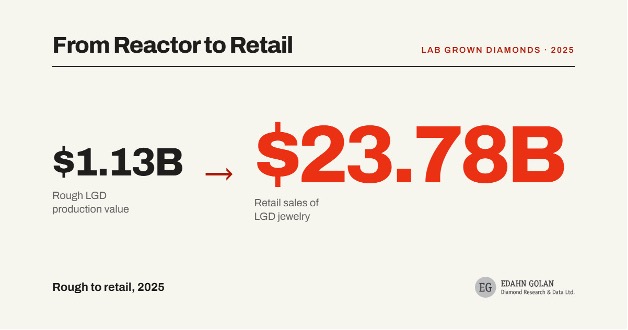
The 2025 Lab-Grown Diamond Value Chain covers another breakout year for the lab-grown diamond industry. Rough diamond prices declined before beginning to recover, India strengthened its position as the dominant production and polishing hub, and retail sales reached a record $23.8 billion, driven by growing demand for lab-grown diamond engagement rings.
According to the 2025 Lab-Grown Diamond Value Chain, available as a free industry analysis and accompanying chart, the year was marked by consolidation in India’s lab-grown diamond sector, as less competitive companies closed or were acquired by larger firms. HPHT rough prices fell to a new low before recovering as a group of growers joined forces to protect profitability. Meanwhile, new retail markets continued to emerge.
The analysis, conducted by Edahn Golan and Eyal Axelrod, reveals the following key findings:
Key Findings
Global production of gem-quality lab-grown diamonds reached a record 69.4 million carats in 2025, only about 30% below the 98.8 million carats of natural rough mined.
Of the $23.8 billion consumers spent on lab-grown diamond jewelry in 2025, only about 3% went to growing the diamonds; roughly 95% of the value was created after the stones left the grower.
India grew about 8% more gem-quality lab-grown carats than China in 2025 and polishes virtually all of the world’s lab-grown diamonds.
A lab-grown carat cost less than $11 per carat to grow and was worth about $16 per carat as rough in 2025, compared with about $93 per carat for natural rough.
Cutting and polishing lab-grown diamonds cost about $1.23 billion in 2025, more than the $1.13 billion value of the rough itself.
Lab-grown diamonds accounted for 53% of engagement rings sold by US specialty jewelers in 2025, but only 27% of diamond engagement ring sales value.
The Bottom Line
The 2025 LGD Value Chain reveals an industry with an economic value that extends far beyond diamond production, fully focused on tech applications.
While growing costs kept declining, cutting, polishing, distribution, and retail accounted for the overwhelming majority of the value created along the supply chain. Understanding where value is generated, and who captures it, is vital for businesses assessing opportunities, competitive positioning, and the future direction of the lab-grown diamond market.
2025 Lab-Grown Diamond Value Chain: Methodology
The analysis is based on primary research conducted by Edahn Golan and Eyal Axelrod among lab-grown diamond growers, traders, and retailers across the main production and consumer markets.
US retail and consumer data was provided by Tenoris.bi.
Production, cost, and value figures represent estimates for gem-quality lab-grown diamonds only and exclude industrial-grade output. Wholesale and retail values refer to diamond content unless otherwise stated. All values are expressed in US dollars and cover calendar year 2025.
About the Author:
Edahn Golan
Edahn Golan has 25 years of experience as a diamond industry analyst and is regarded as a leading expert on the workings of the diamond supply chain. He has a unique ability to provide a global perspective alongside the exclusive granular data he shares. His extensive client list includes all the industry’s major companies, the most prominent consulting firms, and numerous financial institutions. Leading publications frequently quote him.